


Smart Tachograph Penalties Now Being Enforced Across Europe
International transport operators face real fines for non-compliance.
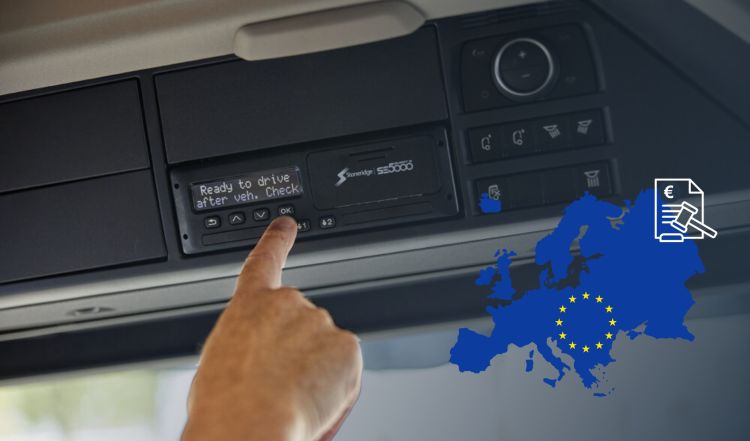
Since March 2025, European authorities have officially ended tolerance periods and begun issuing penalties to vehicles operating in international road transport without the required second-generation Smart Tachograph (G2V2) installed.
The transitional period has formally ended. Inspections across EU Member States are resulting in real sanctions, including substantial fines, vehicle immobilization, license suspensions, and reputational consequences for transport companies. Compliance with tachograph regulation is no longer optional, but a critical legal and operational requirement.
What the Mobility Package Requires
Under Regulation (EU) 2020/1054, part of the EU Mobility Package, vehicles engaged in international transport must be equipped with the second-generation Smart Tachograph (G2V2).
Key deadlines include:
- 31 December 2024: Mandatory retrofit for vehicles with analog or older digital tachographs operating internationally;
- 20 August 2025: Mandatory retrofit for vehicles equipped with first-generation Smart Tachographs;
- 1 July 2026: Requirement extended to light commercial vehicles above 2.5 tons engaged in international transport.
Failure to meet these deadlines exposes operators to immediate enforcement under EU transport legislation.
End of the Tolerance Period
Authorities across Europe have begun actively applying tachograph infringement fines. Industry reports confirm that roadside inspections are already identifying and penalizing non-compliant vehicles, particularly in cross-border operations.
Enforcement is rigorous in international corridors, where compliance checks are frequent and coordinated between Member States.
Examples of Penalties Across Europe
According to Trans.Info, penalties for failing to install the Smart Tachograph vary significantly between countries:
- Spain: Fines up to €2,001, possible vehicle immobilization, and impact on the company's "good repute".
- Italy: Fines between €866 and €3,464, potential license suspension, and obligation to regularize within 10 days.
- France: Fines that can reach €30,000, with possible criminal penalties in severe cases.
- Slovakia and the Netherlands: Fines exceeding €10,000 in certain circumstances.
For companies engaged in international road transport, non-compliance can quickly become a costly operational disruption.
Technology as a Compliance Safeguard
Beyond installation of the correct Smart Tachograph, companies must ensure proper data handling and monitoring to remain compliant.
A structured compliance approach includes:
- Timely tachograph upgrades;
- Remote tachograph data downloads;
- Driving and rest time monitoring;
- Secure and traceable data archiving;
- Automated compliance alerts.
Integrated fleet management solutions play a critical role in mitigating compliance risk by automating remote data downloads, reducing administrative errors, and helping ensure vehicles are compliant before crossing borders.
Compliance Is a Strategic Imperative
The enforcement of Smart Tachograph requirements marks a new phase in EU mobility and transport regulation. For international operators, compliance is about protecting operational continuity, maintaining competitive standing, and ensuring cross-border reliability.
Is your fleet fully compliant with Smart Tachograph requirements? Talk with our fleet management experts to ensure your vehicles are prepared for international inspections and avoid costly penalties.